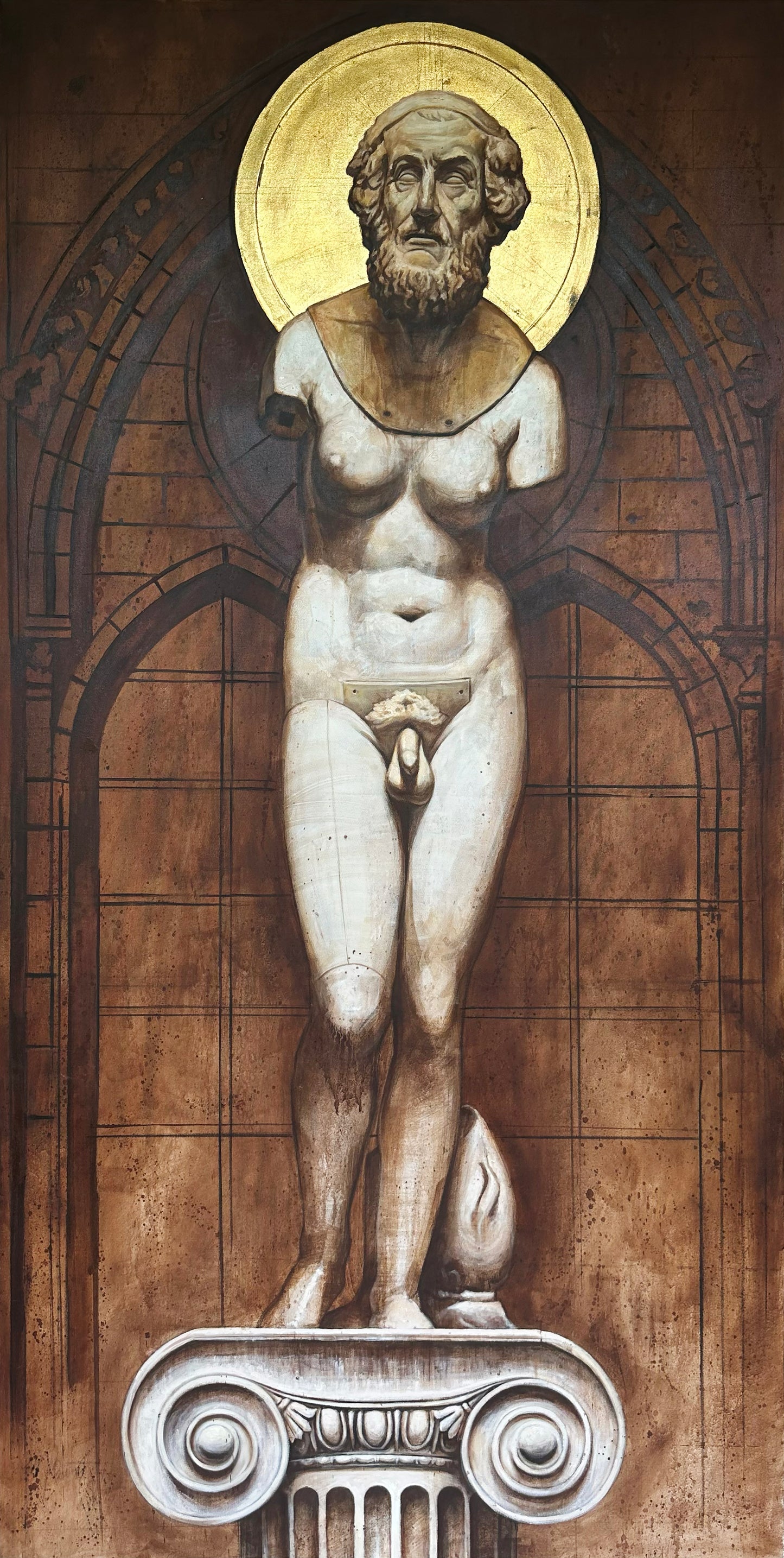
Oil on Canvas, Unframed 71"x36" / 180cm x 90cm
1
/
of
1
White Cloud Gallery
Moral Compass
Moral Compass
Regular price
$5,600.00 USD
Regular price
Sale price
$5,600.00 USD
Quantity
Couldn't load pickup availability
This painting by Cuban artist Maikel Benítez unfolds as a deliberate puzzle—an intricate merging of iconic sculptural forms reassembled to challenge our inherited notions of identity, knowledge, and power. The artist interlaces the venerable head of an ancient philosopher or poet—evoking the likeness of Homer—with a fragmented classical Aphrodite/Venus body, completed by the unmistakably masculine organ of Michelangelo’s David. From these dissonant parts emerges a singular, arresting figure: neither quotation nor pastiche, but a newly forged symbol.
Elevated atop a column, the figure exists in a state of reverence and rupture. The radiant golden halo behind the head recalls Byzantine iconography, lending the hybrid form a sacred authority. Yet this sanctity is immediately unsettled by the body it inhabits—exposed, powerful, and visibly altered. Here, mismatched anatomy becomes a symbolic battleground where intellect and corporeality, wisdom and vulnerability, masculine and feminine coexist without hierarchy or apology.
Benítez proposes a “new Renaissance,” one that does not preserve classical ideals in marble stasis but subjects them to contemporary ethical inquiry. By swapping, joining, and recontextualizing sculptural fragments, the artist questions the foundations upon which Western cultural ideals were built. The historically gendered body—female and male at once—is crowned with a saintly glow and posed with quiet dignity and fragility, dismantling rigid definitions of gender, authority, and heroism.
Ultimately, the work radiates an atmosphere of contemplative provocation. It invites the viewer to reconstruct meaning just as the artist has reconstructed form—to reflect on whose bodies, voices, and narratives have been canonized, and how reimagining these icons can open space for inclusivity, gender fluidity, and empowerment. In Benítez’s hands, the classical canon becomes living material: mutable, critical, and urgently present.
Share